



Vanya Veras,who has been Secretary-General of the EERA since April 2026, accepted MGG’s invitation to visit Amstetten and Kematen/Ybbs and came in person to see this flagship company for herself.
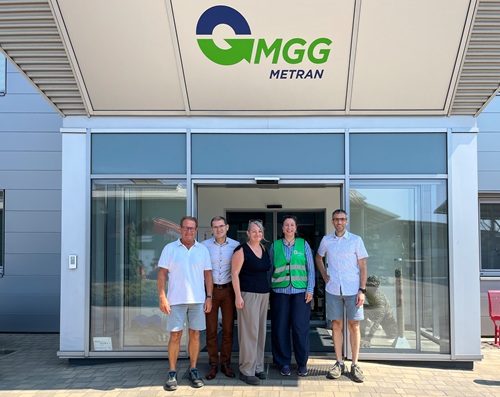
Metran Managing Director Gunther Panowitz (1st from left) gave a tour of the company, accompanied by (from left): Michael Kimmeswenger, Lisa Maria Rainer, Vanya Veras and Daniel Forstner.
The aim of the visit in early July was to get to know one another through a personal, in-depth exchange of ideas and to put forward the company’s concerns. To illustrate MGG’s recycling philosophy in practice, a detailed programme of visits was on the agenda, taking the Secretary-General to Metrec, Metran and Polymers. This enabled Veras to observe the entire e-waste processing chain at first hand.
A prime example of this was the recycling process for a robot vacuum cleaner: the professional removal of batteries, followed by mechanical shredding to separate the various fractions. High-quality metals such as steel, aluminium and copper are recovered and reintroduced into the production cycle (“urban mining”). The recycled plastic is processed into high-quality recyclates and used as a premium material for the production of new electrical appliances. (“We close the loop”).
Many topics – much to discuss
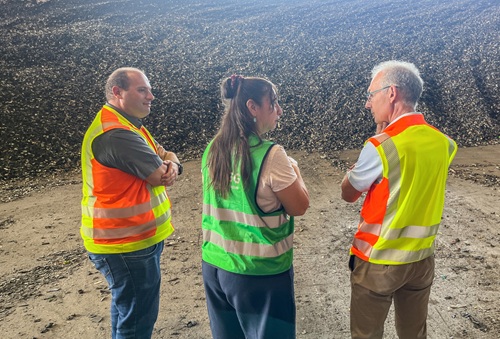
Stimulating discussions took place during the tour: Philipp Felber, Vanya Veras and Maximilian Hager (from left).
A number of topics were on the agenda, with the ‘Waste Shipment Regulation’ at the top of the list. This EU regulation governs the cross-border transport of waste within the European Union, as well as imports and exports to and from third countries. DIWASS, a digital platform for waste transport, and the ‘Critical Raw Materials Act’ were also on the list. The aim of this EU initiative is to secure Europe’s supply of critical raw materials and to significantly expand the recovery of valuable raw materials from recycling processes. From MGG’s perspective, it would be an important step if such high-quality secondary raw materials were treated more as products and less as waste in future, as this could reduce numerous practical and regulatory challenges along the value chain.
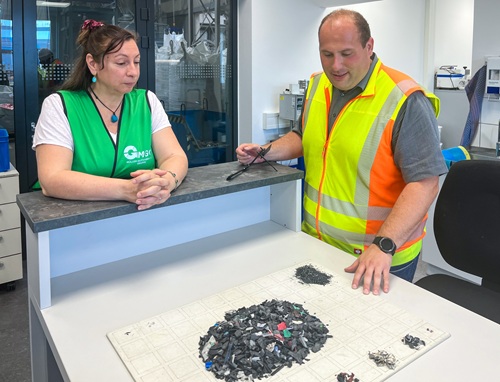
Fascinating details in the Polymers laboratory too: Philipp Felber in conversation with Vanya Veras.
It was also pointed out that, unfortunately, the collection of e-waste is regulated differently across Member States, which makes international cooperation more difficult. The lithium-ion batteries that often remain in e-waste – which repeatedly cause dangerous fires when disposed of improperly – were also a topic of discussion. Stricter and mandatory minimum standards for the recycling of e-waste are currently being discussed at European level. At MGG, work has been underway for years to meet these strict CENELEC requirements.
Generally speaking, the situation in the industry is challenging. The market environment for recycled plastics is difficult, with cheap virgin material from Asia flooding into Europe. Unfortunately, the CO₂ benefits of recycled plastic are not a selling point. Added to this are increasingly stringent limits, currently in the area of flame retardants.
Secretary-General Veras was impressed. Having promised to take the points raised in the discussions on board and present them accordingly, she bid farewell to Amstetten and Kematen/Ybbs after two exciting days.
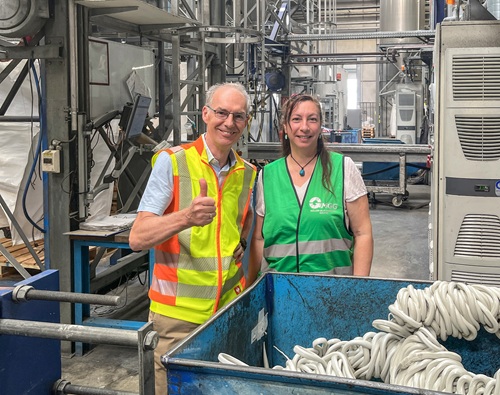
Maximilian Hager, Managing Director of MGG Polymers, introduces Vanya Veras to the company in Kematen an der Ybbs.
About Vanya Veras
The European Electronic Waste Recyclers Association (EERA) has appointed Vanya Veras as its new Secretary-General with effect from 1 April 2026. Veras has more than 30 years’ experience in the fields of environmental policy and sustainability, as well as in working with various stakeholder groups, including around 20 years in waste management. Her career highlights include a role as Environmental Affairs Manager at Coca-Cola in Greece and as Special Adviser on waste issues to the Mayor of Piraeus. She has also previously served as Secretary-General of Municipal Waste Europe, the European association of municipal waste management organisations.