



In March 2026, a composite recycling plant – the only one of its kind in the world – began operations at MGG Metran. This enables the recycling experts in Kematen an der Ybbs to recover even more high-quality secondary raw materials, such as copper, aluminium and tin, from consumer waste collected in the yellow bag and small electronic waste.
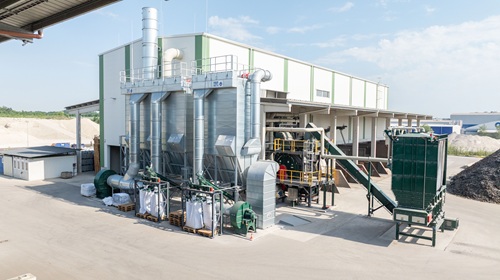
The new Hall 10 at MGG Metran in Kematen houses Vera, the new composite materials processing plant.
Anyone who squeezes an empty mustard tube and puts it in the yellow bin today probably doesn’t give a second thought to what happens to this waste. For Gunther Panowitz, Managing Director of MGG Metran, and his recycling team, however, it is precisely at this point in a mustard tube’s product life cycle that a new story about raw materials begins: “Hardly anyone asks themselves whether or how mustard tubes, Matchbox cars, lighters, e-cigarettes or disposable razors are recycled. We do! Because for many people, these small everyday items have reached the end of their life as soon as they end up in the yellow bag. For us at Müller-Guttenbrunn, however, they are valuable raw materials at the start of the recycling cycle.”
The result of years of deliberation on how to recycle composites even more effectively has been in operation at Metran in Kematen an der Ybbs since spring 2026 and goes by the name of “Vera”.
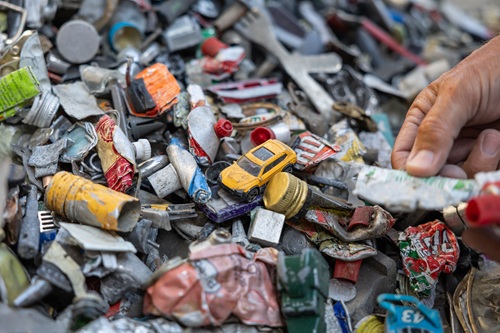
Thanks to Vera, MGG Metran recovers high-quality secondary raw materials from source materials such as mustard tubes, Matchbox cars, perfume bottles and lighters.
This innovative plant has been running in trial operation in the newly constructed Hall 10 since March. Vera is a highly complex recycling plant that mechanically breaks down composites and recovers high-quality secondary raw materials from them. Whilst this may sound straightforward, it marks a technological milestone for Metran. This is because the plant processes materials that have previously posed major challenges for the recycling industry – materials that were often incinerated or considered difficult to recycle:
- Mustard tubes and tomato purée tubes,
- E-cigarettes and lighters,
- Disposable razors, deodorant cans and perfume bottle caps,
- Matchbox toy cars,
- Aluminium trays and coffee capsules,
- Small electronic parts and electronic waste,
- Components of photovoltaic modules,
- Packaging made from aluminium composites,…
“When you look around your home, you realise just how many everyday products are actually composites – that is, materials made up of two or more different metals or non-metals,” says Panowitz.
As well as consumer waste, it is hoped that Vera will also lead to further developments in the recycling of photovoltaic modules. Whilst aluminium frames from PV systems can already be recycled relatively easily, the complex composite layers inside remain a challenge. That is why the aim is to use Vera in future to separate the fine conductor tracks and metal components from the PV modules as well. Initial promising trials are currently underway to increase the recycling rate for PV modules.
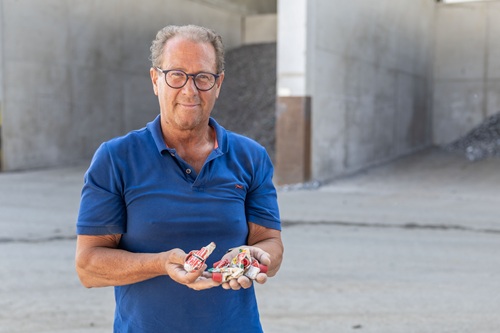
Metran’s Managing Director, Gunther Panowitz, has worked with his development team to create intelligent process chains for the treatment of composite materials using Vera.
The Breakdown. Or: How do I take apart a Lego house?
At the heart of the new plant is a process developed by the MGG development team under the leadership of Panowitz, which the ‘tinkerer’ at Metran describes with a single term: disassembly. ‘When you build a house out of Lego bricks, you end up with a finished product made up of many different bricks. Many everyday products are likewise made from many individual parts and different materials. What we do in recycling is break the Lego house down into its original components. We call this separation into individual raw materials ‘disintegration’,” he explains vividly. And that is exactly what happens at Vera. The plant separates composite materials into their individual components. Metals such as copper, aluminium, brass, tin, zinc and other materials are mechanically exposed and then sorted by type.
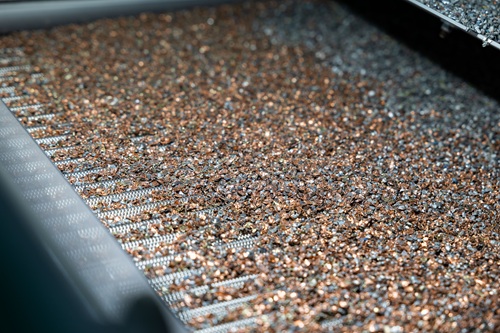
Grinding, screening and separating! Or as the developers of Vera at MGG Metran put it: “The trinity of composite separation!”
The trinity of composite separation: grinding, screening, separating!
Some of the technologies used in the Vera plant originate in part from sectors that, at first glance, appear to have little to do with recycling: the food industry. “Our task is similar to separating the chaff from the wheat,” explains Panowitz. “Many machines used in food processing are now also used in recycling. For example, when you sort stones or black grains out of rice, technically speaking, this is relatively similar to extracting copper grains from a pile of aluminium.” Grinding, screening, sorting, density separation or processes using air flows – Vera combines a wide variety of mechanical systems in a complex process chain, which was created for the first time worldwide by the Metran developers. The key factor here is not the individual machine, but the interplay of the different technologies. “The expertise lies in the sequencing. Which plant, in what order, leads to which result – that is the crucial point,” explains Gunther Panowitz. And this Metran has built up and refined its expertise over decades. Since as far back as 1984, the company has been working on mechanical processing technology to optimise recycling rates. With Vera, this development is now entering a new dimension. For the Metran team, the main aim of Vera is to ensure that as much as possible of what we, as a consumer society, discard is returned to the product cycle as raw material.
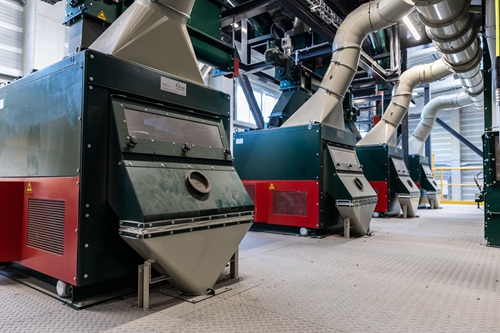
Vera is the largest investment project to date in the history of MGG Metran. Around twelve million euros have been invested in machinery, infrastructure, hall construction, energy supply, water treatment and safety technology.
A plant that is constantly learning
A key focus of the new plant is the metal content from the yellow bag. What was previously often regarded as low-grade mixed waste is now specifically utilised as a high-quality raw material, explains Panowitz: “A mustard tube, for example, is primarily made of a very high-quality aluminium alloy. When it is empty and ends up in the yellow bag, it still contains enormous value. The challenge lies in separating the materials cleanly from other components – for example, separating the plastic cap of the mustard tube from the rest of the aluminium tube. This is precisely where Vera comes in. In our new plant, we primarily recover non-ferrous raw materials such as copper, zinc and aluminium to high degrees of purity and in a wide range of particle sizes. The range of recovered secondary raw materials extends from fingernail size to a few tenths of a millimetre. And these can later be used to produce new tubes or other products.”
For the Metran plant developers at Vera, the purity of the material was particularly important. The more thoroughly aluminium or copper are mechanically separated at an early stage, the less energy is required later during smelting. “The purer the copper we produce, the less energy the copper smelter then needs to remove impurities such as tin using resource-intensive pyrometallurgical separation. This saves gas, electricity and, ultimately, CO₂,” explains Panowitz.
Even though Vera is already officially up and running, Panowitz does not consider the plant to be anywhere near “finished”. “A plant like this is constantly evolving,” he says. “We’re optimising air volumes, material distribution and vibrations, and creating programme sequences for different raw materials. After all, every group of materials behaves differently. The first few weeks were dominated by tests and basic set-ups, and now the real fine-tuning is beginning to improve output.”
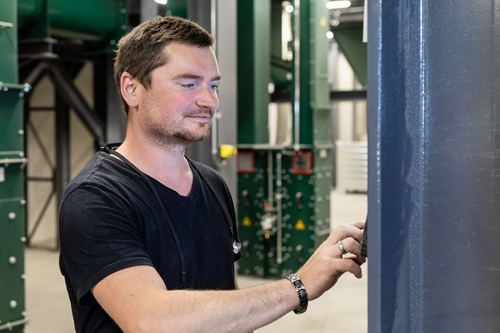
To operate the new plant, five new staff members have also joined the Metran team.
A multi-million investment in the future
The new facility is MGG Metran’s largest investment project to date. Around twelve million euros have been invested in machinery, infrastructure, the construction of the hall, energy supply, water treatment and safety technology.
For Metran, Hall 10 represents an important step in its expansion. The launch of Vera has also created new jobs. Five additional staff members have been recruited specifically for the facility. “Together with the new team members, we are learning every day how we can further develop Vera – and, in turn, ourselves. After all, every change in air volumes, angles, material flows, speeds, rotational speeds or vibrations affects the recycling outcome.”
Vera: Recycling reimagined
To sum up, it is clear that what has been created in Hall 10 is far more than just a new machine at MGG Metran. Vera represents a step forward in the processing of waste fractions from consumer goods. Products that were previously considered virtually unrecyclable are now being turned into valuable secondary raw materials in a wide variety of particle sizes and degrees of purity. Well-designed new mechanical processing chains ultimately save energy and reduce CO₂ emissions. Complex composite materials are being transformed back into single-type materials. Or, as Gunther Panowitz puts it: “In truth, it’s all about ensuring that as much waste as possible is recycled sensibly!”