



Manuel Riedl, managing director of Metall Recycling Mü-Gu GmbH and Metran Aufbereitungsges.m.b.H. since the beginning of the year, has been working in the industry for more than 15 years and has been part of the Müller-Guttenbrunn Group team for five years. He tackles his daily tasks with enthusiasm, tact and a genuine passion for his work.
Mr Riedl, you have been working in the waste management industry for 15 years. Tell us a little more about that.
Manuel Riedl: Yes, that’s right. I have been working in the industry for around 15 years, five of which have been with the Müller-Guttenbrunn Group. Before that, I worked for a waste treatment company that collaborates with the Müller-Guttenbrunn Group. At the time, I had been thinking about a career change for quite some time. So the offer from Metrec came at just the right time.
How did you get started at Müller-Guttenbrunn, and what were your responsibilities five years ago compared to today?
Manuel Riedl: Metrec needed someone to take some of the load off Michael Grimm, and that’s why I was brought in. Working alongside him, I was able to get to know the company and quickly become a valuable support to him. My training and technical background were a great advantage in this regard. At the end of 2025, Mr. Grimm stepped down form the Executive Board to prepare for his retirement. Although it will be a few months before he actually retires, he has decided to take things a little easier until then.
And you are succeeding Mr. Grimm as managing director?
Manuel Riedl: That’s right. Following his departure from the management board, since the beginning of the year I have been managing director of Metran Aufbereitungsges.m.b.H – together with Gunther Panowitz – as well as Metall Recycling Mü-Gu GmbH – here in collaboration with Dietmar Berger. My responsibilities at Metrec primarily include technical matters on site, personnel, machinery and equipment, and the associated investments. A significant part of my working time is taken up with dealing with authorities and the associated decrees and regulations.
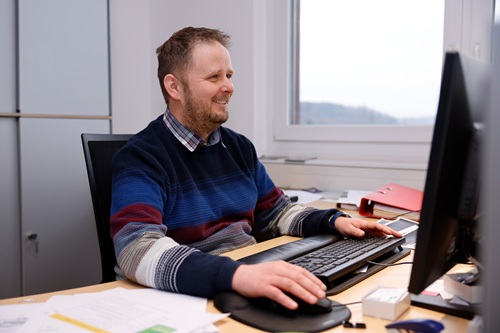
Although Manuel Riedl spends most of his working hours in front of the computer, he makes an effort to be present for his team. At least one tour of the premises every day is part of his routine.
So you are the point of contact for many issues and concerns, both internally and externally. What is a typical working day like for you, and how do you manage to do justice to your team with this workload?
Manuel Riedl: The days are often very – let me put it positively – demanding, and you feel like they are too short. But I like that. Making a difference, getting things on track and moving them forward. And I like working with people. My team is extremely important to me. Good, appreciative communication on an equal footing is my recipe for success in managing employees.
There is no such thing as a typical day in my working life. But there are routines that I have established. One of them is arriving at the company in the morning. On my way to my office, I try to meet as many colleagues as possible and wish them a good morning, asking them, ‘Everything OK?’ I also take I regularly take the time to walk around the pitch. This often allows me to obtain information in a completely informal and direct manner – essentially through the ‘official channels’. It is important to me that my team feels comfortable approaching me at any time. This allows me to identify any issues that need to be addressed, which must be done in a direct and open manner. This is the only way to bring about change. And although I practise close communication, what I appreciate about my team on site is that they work independently and autonomously and know exactly what they are doing. We have a common goal, and the paths to achieving it can sometimes differ. Everyone is invited to contribute suggestions for solutions and try out new things. In the end, we finish together.
What do you particularly appreciate about your employer?
Manuel Riedl: Despite its size, the Müller-Guttenbrunn Group has remained a family business, and not just on paper. I really appreciate that. I am someone who does their job and doesn’t take themselves too seriously. That fits in well with the team spirit at Müller-Guttenbrunn. We enjoy our work and have fun at work. Everyone feels like they are on the same level; no one is stuck on titles or positions. Everyone enjoys their work, and people who enjoy their work perform better!
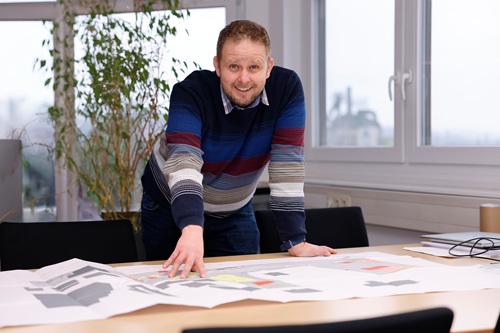
One of the upcoming major projects for which Manuel Riedl is responsible internally is the extensive modernisation of the MGG site in Amstetten.
Is there currently ‘the one project’ that is demanding your attention in particular?
Manuel Riedl: Yes, there is indeed, and that is the extensive modernisation of the MGG site in Amstetten. A plot of land adjacent to the factory premises was acquired some time ago. We are currently in the final planning phase. I expect the necessary permits to be granted in the course of this year. The construction project is scheduled to take five years. Infrastructure such as the petrol station and washing area for trucks will be relocated to the edge of the site so that the central areas can be used for storing the fractions in boxes. A specially secured and fire-monitored area will be created for batteries and accumulators. The entrance and weighbridge will be relocated, the existing hall 4 and hall 2/3 will be demolished, a new office wing will be built, and the old one will be completely renovated and converted into a modern social building. In addition to the structural changes, cables, pipes and installations will also be renewed.
The renovation work poses major challenges for the entire site, as it will take place while operations continue. Here, too, the company’s sensational team spirit comes into play: together we can do it!
Exciting times lie ahead for you and the site. Let’s look a little further into the future: where do you see the major challenges for the industry over the next 10 to 15 years?
Manuel Riedl: I see one major challenge for the future in the ever-changing EU regulations, which are often incomprehensible and incompatible with the reality of recycling. It can happen that a plant is built in accordance with the applicable specifications, but even before completion, the first adaptations are necessary because one or more regulations have changed. This makes recycling increasingly complicated and expensive. At the same time, however, Europe is demanding ever higher recycling rates. In addition, more and more (cheap) goods are being imported that contain large amounts of pollutants. These exceedances of the limits applicable in our country make the recycling process even more difficult. I would like to see controls in the area of goods imports. Because it has long been a fact that raw material scarcity is advancing and many materials can only be extracted or produced at enormous environmental cost. Humanity is dependent on recycling as many materials as possible.
Last but not least, we would also like to learn about Manuel Riedl as a private individual. Would you like to tell us something about yourself?
Manuel Riedl: I worked as an automation engineer at Lenze Antriebstechnik for three years and then studied informal computer science at the University of Applied Sciences in Wels. After that, I started working at Bernegger GmbH, where I was the plant manager in Enns. I live with my partner and our three children (aged 12, 16 and 19) in Ennsdorf, the westernmost municipality in Lower Austria. In winter, we enjoy skiing together, and in summer I spend a lot of time on my mountain bike – an e-bike from the ‘firmenradl.at’ campaign. If I have any time left over, I restore old Vespas. However, I recently bought a modern model for trips, as they offer more comfort.
We would have liked to chat longer, but there is a knock at the door and several employees enter the office with questioning looks on their faces. Manuel Riedl shrugs his shoulders apologetically and charmingly ends the conversation with, ‘Sorry, I have to go…’
Thank you very much for your time and all the best for the future!