



Many consumers still dispose of their used batteries and rechargeable batteries in general waste, which poses serious risks. In particular, the high fire risk posed by lithium-ion rechargeable batteries repeatedly leads to dangerous situations at waste disposal and recycling facilities. Yet there are many options for proper disposal in Austria. However, people often simply lack the knowledge of what is contained in everyday items and where rechargeable or standard batteries are hidden inside them.
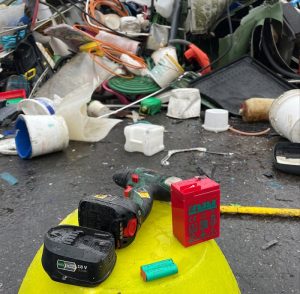
Batteries contain valuable raw materials such as zinc, manganese and nickel; modern rechargeable batteries also contain lithium, cobalt and aluminium. Through proper recycling, a large proportion of these metals can be recovered and reused.
Our modern society is increasingly reliant on mobile, smart and connected products. Rechargeable batteries offer convenience, flexibility and cordless use. The number of everyday items that require power is growing. The problem is that many batteries and rechargeable batteries are barely visible. They are permanently fitted, glued in place or so small that they are often not even noticed when items are disposed of.
Handling things properly saves you from a nasty surprise
Given the widespread use of lithium-ion batteries, it is essential that consumers are made aware of the need to handle them responsibly and with care, as it is not just proper disposal that is important. If used incorrectly, these ‘smart gadgets’ also pose a significant risk whilst in use. Many fires are caused by user error, damage or incorrect charging of the batteries. Prevention in this regard is clearly a matter of personal responsibility. Children, in particular, must be given comprehensive guidance on how to handle these gadgets.
Safe storage and safe charging are essential for trouble-free use. To be prepared for an emergency, you should familiarise yourself with the key measures to take in the event of a fire. Extreme caution is required, as a fire can also release toxic gases. Only attempt to extinguish the fire yourself if it is very small. Ideally, a lithium fire extinguisher should be used for this purpose. If this is not available, sand or a large amount of water can also be used to extinguish the fire. In the event of a larger fire, you must immediately move to a safe distance and alert the fire brigade.
Anything that glitters does not belong in the general waste

According to a study by the Montanuniversität Leoben, around 17 million lithium batteries are disposed of incorrectly across Austria every year and end up in general waste. This means that the number of batteries disposed of incorrectly has risen by 300 % in 10 years (image generated by AI/ChatGPT)
Once these ‘electronic gadgets’ have served their purpose, many of them end up carelessly thrown into the bin. This is probably partly because they often do not look like traditional electronic devices. A greeting card with a music module, flashing children’s shoes, wireless headphones or e-cigarettes are frequently treated as general waste. On top of that, many users are unaware that even the tiniest button cells or mini lithium batteries can be very dangerous. The fact that these items often end up carelessly in the bin has to do with both convenience and a lack of knowledge.
In Austria, old batteries and rechargeable batteries can be returned or disposed of free of charge. They can be returned in shops. Shops that sell batteries must take back used batteries and rechargeable batteries free of charge, regardless of whether a purchase is made there. In addition, waste collection centres, recycling centres and local hazardous waste collection points are available for disposal.
Risk of fire and explosion in the shredder
If rechargeable or non-rechargeable batteries remain in the discarded appliances, this can pose a real danger to recycling facilities. Scrap is delivered to MGG Metrec every day. Mixed metal and plastic fractions are separated at the plant, shredded and temporarily stored until they are transported onwards. This includes discarded everyday items such as toys, e-cigarettes, tools and mobile phones, some of which still contain batteries. These energy storage devices, if not removed, can trigger fires during shredding, which have the potential to endanger human lives or cause significant economic damage. The Müller-Guttenbrunn Group counteracts this risk by equipping all critical areas with state-of-the-art fire detection and fire-fighting systems. Furthermore, rechargeable and non-rechargeable batteries are stored in sand-filled containers on the company premises until they are transported onwards, ensuring that any explosions or fires have no consequences.
Christian Müller-Guttenbrunn, the company’s CEO, is well aware of the risk lurking in mountains of rubbish. The batteries contained within can go unnoticed for months and then, from one second to the next, burst into flames as if out of the blue. “Even in our plants, we are repeatedly confronted with small fires. They usually occur during the day and are immediately extinguished by staff. We are aware of the issue and have years of experience in how best to store these waste fractions. We divide the waste into specific fire compartments and separate high-risk material into smaller piles.” Looking ahead, he would like to see greater accuracy in waste sorting. “I hope that people realise that rechargeable and non-rechargeable batteries shouldn’t simply be thrown into the scrap, but disposed of separately.”
The ‘wow’ factor versus genuine added value
Alongside proper disposal, a fundamental question is increasingly being raised: do more and more everyday products really need to be fitted with electronics? Flashing children’s shoes, glow-in-the-dark T-shirts and flashing greeting cards are examples of products whose practical benefits are often limited. In most cases, they serve primarily as a short-term attention-grabber or as a marketing tool. The ‘wow factor’ plays a particularly big role when it comes to children’s products. Little ones are magically drawn to glowing shoes or flashing toys. At the same time, however, these products are often used for only a short time before ending up in the bin. The built-in batteries or mini rechargeable batteries frequently go undetected.
Of course, there are sensible applications for lighting in clothing, such as reflective or actively illuminated safety vests for cyclists, runners or emergency services personnel. In such cases, increased visibility can actually save lives. However, many flashing consumer products offer no real added value, whilst leading to additional resource consumption and making recycling more difficult. Every additional battery means the extraction of raw materials, energy consumption and, later on, a potential disposal problem. In cheap products in particular, batteries are often permanently fitted and virtually impossible to replace. This results in a disposable product with a short lifespan and an unnecessary environmental burden. The debate about hidden batteries is therefore also a debate about conscious consumption. Not every technical gimmick is automatically a step forward. Often, less electronics in everyday life would not only be more sustainable, but also safer.