



Europe produces more waste than can currently be recycled in a meaningful way. While recycling is strongly demanded both politically and socially, there is a lack of sufficient capacity for those residual materials that cannot be recycled. The waste disposal system is reaching its limits.
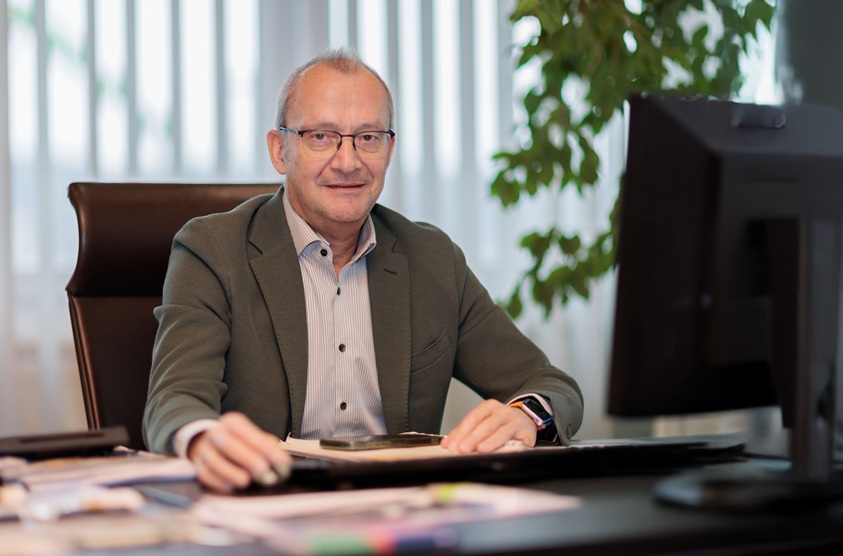
Waste – mainly from Italy – is recycled in Austria. For Christian Müller-Guttenbrunn, CEO of MGG, this is a questionable undertaking when there is more waste in his own country than can be incinerated.
European waste management is in the midst of a paradox: never before has there been so much talk about the circular economy, recycling rates and sustainability. Never before has so much material been recycled. But at the same time, the mountains of waste continue to grow! This is because there is a lack of sufficient capacity for thermal recycling – even in Austria: „In Lower Austria and Vienna alone, there is a need for at least one more waste incineration plant. And this also affects the Müller-Guttenbrunn Group. In our recycling processes in the Mostviertel region, we extract iron, metals and plastics from a wide variety of source materials. This means that only a small fraction of waste has to be thermally recycled. Nevertheless, we are confronted almost daily with the fact that the capacities of the incineration plants in our area are limited,‘ says MGG-CEO Christian Müller-Guttenbrunn, summing up the ’hot“ topic.
In Austria, as in the rest of Europe, waste volumes are rising steadily. Population growth, increasing consumption, packaging intensity and short product life cycles are ensuring that more and more waste is being generated. At the same time, recycling is reaching its technical and economic limits for many materials.
Growing mountains of waste defy recycling campaigns.
Not all plastics can be recycled effectively, many composites are difficult to separate, and heavily contaminated fractions ultimately end up in residual waste recycling despite separate collection. While ambitious recycling targets are being formulated politically, the proportion of waste for which there are hardly any high-quality recycling options is growing in parallel. In practice, this waste often ends up in thermal recycling – provided that sufficient capacity is available.
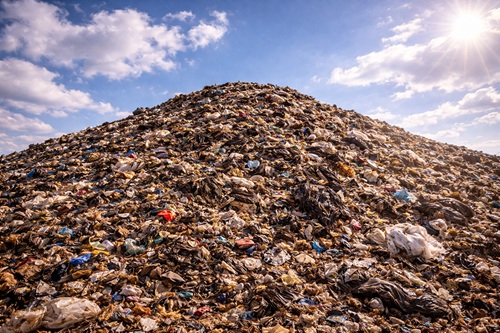
Mountain of trash (AI-generated image/ChatGPT)
Where capacity is lacking, a market automatically emerges. The European waste trade has expanded significantly in recent years. Waste is transported across Europe to find available recycling capacity. Waste from other countries – especially Italy – is imported into Austria and recycled here. This trade is regulated by law and makes sense in principle, as it makes better use of existing facilities. ‘But it is questionable how sustainable these transnational transports are when there is already more waste in our own country than can be incinerated. In this market, it’s really all about money,’ reports Christian Müller-Guttenbrunn.
Interim storage instead of recycling.
Austrian recyclers are therefore increasingly fighting for slots at incineration plants in order to be able to deliver material. If neither recycling nor incineration is possible in the short term, there is often only one option left: interim storage. In many European countries, larger and larger waste storage facilities are being built – some as approved temporary storage facilities, others as emergency solutions for overloaded plants. This is particularly problematic in the case of high-calorific waste or substitute fuels, which are actually intended for energy recovery.
As a result, the mountains of waste are also growing at Austrian recyclers. And in extreme cases, these mountains can become major environmental challenges, as the fire at a Tyrolean recycler last year showed. For days, an entire region held its breath and was confronted with the effects of this conflagration. Christian Müller-Guttenbrunn believes ‘that such fires are a home-made problem. No recycler wants to store these mountains. Because it is neither economically nor environmentally wise. The Ministry of the Environment knows this, and there are repeated discussions on the subject. But the opinion of politicians in this case is: this is a market economy issue in which we do not want to intervene politically.’
The horror scenario of burning mountains of rubbish.
Mountains of rubbish always pose a certain fire risk because they contain a wide variety of fire sources, such as batteries. These can remain inconspicuous for months and then suddenly start burning out of the blue, as Müller-Guttenbrunn reports: „We are also confronted with minor fires in our plants time and again. They usually occur during the day and are immediately extinguished by employees. We are aware of the issue and have years of experience in how best to store these fractions. We always divide the waste into certain fire sections and, as far as possible, separate the risky material into smaller piles.“
At MGG, we are seeing that the proportion of batteries in recycled material is constantly increasing. Given the technological advances and digitalisation of our society, this is a logical consequence. Our affluent society is using more and more battery-powered devices. For example, sales figures for e-bikes are rising steadily. The batteries used in these bikes are highly efficient, but they also have a limited service life. ‘It’s not a huge issue yet, but e-bike batteries are becoming more common in recycling fractions. However, I hope that waste separation accuracy will improve and that people will realise that large batteries should not simply be thrown away with the rubbish, but disposed of separately.’ In addition to e-bike batteries, mobile phone batteries and power banks are also potential fire hazards, as they contain a lot of energy in a very small space. ‘If, for example, a power bank falls onto a stone floor, I would no longer be so careless and would simply place it on my bedside table next to my bed. Extreme caution is advised, especially with potentially defective batteries!’
More waste incineration plants are needed.
One possible solution could be to build new incineration plants. However, there are hardly any companies considering such a project. This is because the construction of new plants often takes ten to fifteen years, from planning and approvals to completion. At the same time, such projects often encounter political resistance or local citizens‘ initiatives. Potential builders of additional plants are always confronted with regional opposition, as Christian Müller-Guttenbrunn knows from his own experience: „When it comes to building new recycling or waste incineration plants, the selfish Florian principle often prevails: Saint Florian, spare my house, set fire to others! People are aware of the problem and the possible solution, but they don’t want it in their own neighbourhood. True to the motto: Not In My Backyard!“
What might solutions look like? What are the possible prospects? These are not easy questions to answer. The issue is not new, but it is coming to a head. The result is an increasingly complex market for waste trading, rising inventories and growing challenges for the entire waste disposal industry. Recyclers are inevitably confronted with rising mountains of waste, and at the end of the day, consumers will have to pay the price because waste volumes will not decrease in the short term.
Sustainable waste management therefore requires not only better recycling rates, but also realistic solutions for the ever-growing mountains of waste, as Christian Müller-Guttenbrunn summarises: ‘Thermal recycling is not growing at the same rate as waste production. So the real problem is not just the waste itself. It is the lack of infrastructure to treat it responsibly and recycle it efficiently!’