



He possesses mental strength, isn’t in it for quick success, works tirelessly towards his goals and is a gifted networker. These qualities benefit Erik Pokorný, who is responsible for sales in Eastern Europe at Metran and Metrec, not only in his professional life. To balance out his demanding job, the Slovakian-born Erik runs marathons. He most recently competed in Tokyo!
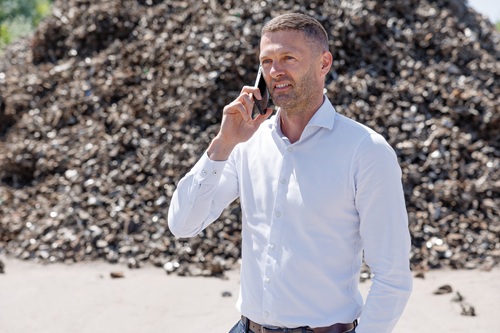
Erik Pokorný is a networker. He is a reliable point of contact for his customers and suppliers.
Mr. Pokorný, you moved to Austria from your home country, Slovakia, for this job. How did that come about?
Erik Pokorný: I’d just handed in my notice at my job in Slovakia – I was working in the scrap metal industry there – and decided to take a longer break. Only after that did I want to start actively looking for work. On my penultimate day at work, I was in contact with a representative of the Müller-Guttenbrunn Group. When he found out that I’d handed in my notice, he got in touch again, this time with a job offer. I was then invited to Amstetten for a face-to-face interview. We hit it off straight away, and I decided to take up a new job instead of taking the break I’d planned.
What made you decide to accept the offer from the Müller-Guttenbrunn Group?
Erik Pokorný: I studied at the University of Economics in Slovakia for five years. It was important to me to further my education and broaden my horizons. After completing my studies, I took on jobs that brought excitement and new experiences into my life, offered me opportunities for development, and allowed me to expand my experience and networks. Ultimately, I decided against taking the planned break at the time because I was certain that the role on offer matched my expectations. That’s why I was also prepared to contribute all my knowledge and expertise to Müller-Guttenbrunn. I was confident that I would be able to develop further in this job. I was put in charge of purchasing and sales, as well as drop-shipping operations for the Eastern European market. My language skills are a great asset in this role. Initially, I worked from Slovakia, but after about half a year I moved to Austria – to a town situated almost exactly halfway between Vienna and Bratislava, which was strategically perfect for my role.
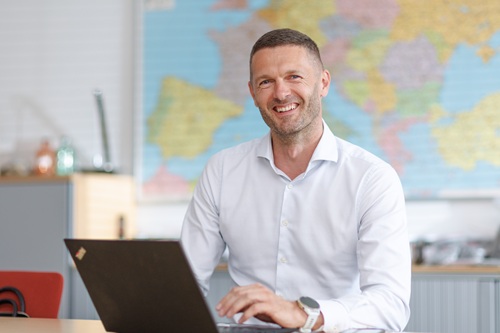
Erik Pokorný is often on the move; he doesn’t have a fixed office. A car, a laptop and a smartphone are all he needs.
Where is your base, your office?
Erik Pokorný: I don’t need an office. Basically, a telephone, a laptop and a car are all I need to do my job. I’m on the road a lot and often work from hotels. I’m usually in Amstetten every two weeks to meet with my colleagues in person. That’s how I get an overview of what’s currently happening at Metec and Metran, which materials are in particularly high demand, or where new ideas are needed in sales. My back-office is also based in Amstetten; they take the pressure off me and handle the administrative work for me. I really appreciate this support, as it’s the only way I can concentrate fully on my tasks.
How do you work? Is there such a thing as a ‘typical’ working day?
Erik Pokorný: What’s typical about my job is that every day, every negotiation and every business partner is different. Sales is still characterised by personal relationships and ‘face-to-face’ meetings. You meet up, have a chat and negotiate. That’s the only way to maintain trust in the industry. It’s the only way to find out which trader currently has which goods in stock, or who needs what on the copper, aluminium or zinc markets. Particularly when it comes to consignment sales, it’s important to have a good, extensive network and to always stay on the ball. That’s the only way to stay in the loop and be in a position to secure lucrative deals. It’s like the stock market: prices rise and fall, creating a dynamic that ensures no two days are the same. You’re constantly faced with new situations that demand tailored solutions. Sometimes there’s a shortage of material on one side, sometimes on the other. Or prices might fall just when you’re in the middle of negotiations, and a good deal risks turning into the opposite. It’s these challenges that I value so much about my job. But I also enjoy working as part of a team. When there’s a ‘short-staffed’ situation internally, I pitch in. For example, I often help my colleagues in Romania, the Czech Republic and Hungary with communication.
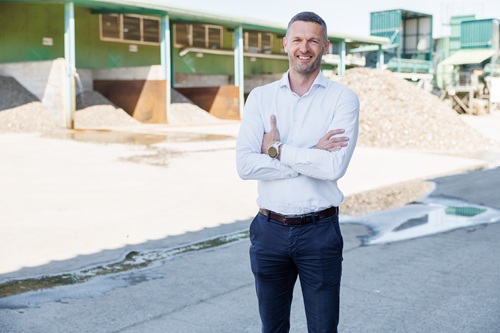
Every two weeks, the sales specialist visits head office to liaise in person with his colleagues there.
What makes working for the Müller-Guttenbrunn Group so special for you?
Erik Pokorný: MGG has built up a good reputation in the industry. The company doesn’t chase after every ‘lucrative, quick’ deal, but focuses on continuity and long-term, sustainable partnerships. This means that we don’t just take on the deals that yield the highest profit, but that we work with long-standing partners we can rely on. They, in turn, value our stability and the integrity that has characterised the company for many years. These qualities, in turn, give me confidence and strength in my negotiations.
And what about you personally?
Erik Pokorný: Everyone here has been open with me right from the start. I was impressed from the outset by the fact that communication within the company takes place on an equal footing; nobody tries to take centre stage. Although the Müller-Guttenbrunn Group is a sizeable organisation, it remains a family business – and not just on paper. You can sense everywhere here that the staff are not just a number. There are lots of internal team-building activities that foster a sense of unity amongst the workforce. The management acts with foresight and attaches great importance to steering the company successfully into the future. The Müller-Guttenbrunn family invests a great deal, which I personally find very impressive. The fact that Max Müller-Guttenbrunn, representing the next generation, is already working in the company clearly underlines this mindset once again.
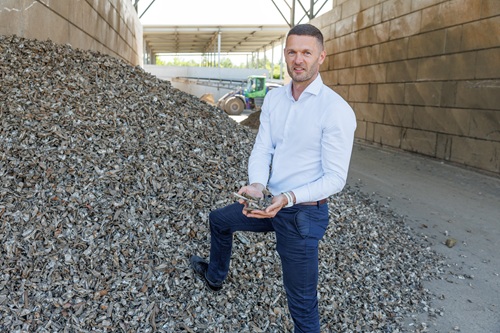
During one of his regular visits to Amstetten, he also took a look around the Metran site.
Let’s take a little peek behind the scenes: who is Erik Pokorný in his private life?
Erik Pokorný: As I mentioned at the start, I moved from Slovakia to Austria in 2015. I live with my wife and our two daughters in a town east of Vienna. Our eldest daughter – she’s 13 – was born in Slovakia, whilst our younger daughter is 10 and was born here in Austria. I devote most of my free time to my family. We love spending lots of time together, going on day trips or travelling. My greatest passion – apart from my family – is running. I try to find time for it as often as possible. The handy thing about this sport is that you can do it anywhere. A while ago, I started running marathons. For me, it’s not primarily about the finishing time. I’m much more interested in the mental strength it takes to finish. From kilometre 30 onwards, good physical training alone isn’t enough; that’s when your mind comes into play. You can only manage the last twelve kilometres with the right mindset. My goal is to run all six of the world’s ‘major’ marathons; last spring I was on the starting line in Tokyo.
One final question: How do you see the recycling industry over the next five to ten years?
Erik Pokorný: When I first entered the industry, there weren’t many companies with significant expertise in separating materials. Today, there are far more competitors in the market, although many of them only do what is easy. This is a trend that will continue in the future. Renowned firms such as the Müller-Guttenbrunn Group are therefore forced to continually develop new processes that go ever deeper into the separation and recycling of materials. At Metran, for example, work is currently underway on new processes designed to increase the purity of non-ferrous metals. To this end, the company has invested in a new production hall and the necessary equipment. Another factor that is becoming increasingly challenging is the ever-growing number of restrictions and bureaucratic hurdles, which are making collaboration – even within Europe – increasingly complex. There is an urgent need for action here. Rising energy costs are also placing a strain on the industry. I am not, however, concerned about the future of the Müller-Guttenbrunn Group in particular. It has been firmly established for many years, operates with confidence and professionalism, and will therefore continue to hold its own in the market.
We would like to thank you very much for the interview and wish you all the best for the future!