



With the expansion and modernisation of the laboratory, MGG Polymers is taking an important step in the further development of its quality assurance. For Philipp Felber, Quality Manager at MGG Polymers GmbH, the laboratory is far more than just a place for measurements and tests. It is a central hub linking goods receipt, production, product development and customers.
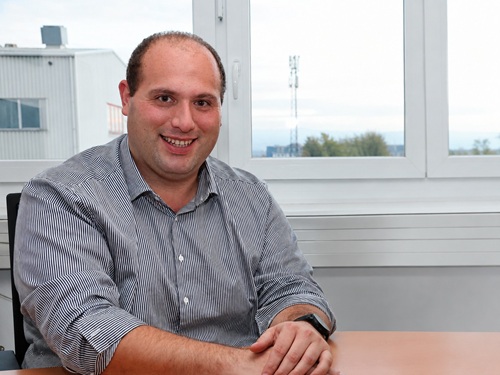
Philipp Felber is the quality manager at MGG Polymers GmbH. For him, the new laboratory represents an investment in the company’s technological expertise.
Whilst the company’s premises have been continuously expanded since it opened in 2006, the demands and tasks in the laboratory have grown, but the space has not. Over time, new processes and equipment have exacerbated the shortage of space. A refurbishment was inevitable.
After 20 years, the time has now come: the quality department has been expanded and modernised. An extension has doubled the space available for testing purposes. At the same time, the office space has been modernised and additional meeting facilities created. Testing equipment, some of which had previously been housed in production areas due to the lack of space, has been reintegrated into the laboratory. Operating on a three-shift basis, two staff members work in the laboratory per shift. In addition, there are the quality engineering, product development and quality management teams themselves. With the increasing number of tests, pieces of equipment and quality requirements, the newly created space is already being put to intensive use.
The planning was not simply based on additional square metres. The key factor was the workflow. The laboratory’s layout was planned well in advance. Testing equipment, workstations and access routes were arranged in such a way as to create the shortest and most efficient process routes possible. For Philipp Felber, this was a crucial point: “In a three-shift operation, unnecessary walking distances quickly add up to a considerable amount of effort. A well-planned layout has a direct impact on the efficiency and quality of the work.”
New testing apparatus assesses the fire behaviour of recycled plastics
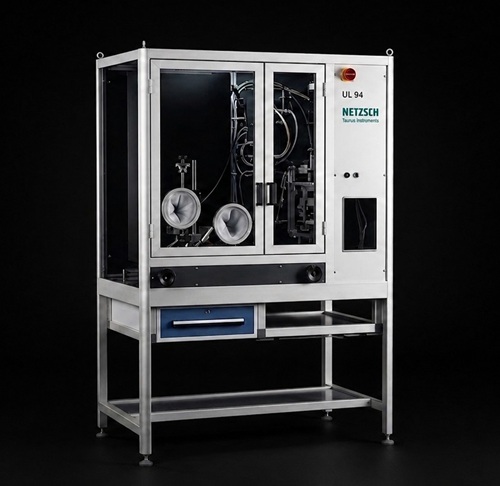
A fire test chamber is used to test the fire behaviour, flammability and burning rate of recycled plastics (recyclates) under strictly controlled conditions.
The demands placed on quality management have risen steadily in recent years. Today, customers expect not just a recycled material, but a raw material with clearly defined and reproducible properties. At the same time, legal requirements must be met and every stage of production must be documented in a traceable manner. This is precisely where quality assurance comes in.
“In many applications, our customers require certification in accordance with recognised testing standards such as UL94,” explains Felber. This is an internationally established testing standard for the fire behaviour of plastics. For certain products or customer applications, it must be demonstrated how the material behaves when exposed to flame. To this end, plastics are tested under defined conditions and assessed in terms of their fire behaviour. The new laboratory has its own fire test chamber for this purpose. “Depending on the specific application, additives are incorporated into the recycled plastics to alter their fire behaviour and reduce the spread of flame. Quality assurance must ensure that the required product properties are actually achieved and consistently maintained throughout ongoing production,” the quality manager continues.
Quality starts with goods receipt
What fundamentally distinguishes Polymers’ laboratory from those of a plastics manufacturer is the fact that the process does not begin with a specifically defined primary raw material, but rather with a heterogeneous input material. MGG-Polymers, for example, purchases shredded fractions from waste electrical and electronic equipment. In addition to the desired plastics, these contain numerous other materials such as aluminium, cables, rubber, printed circuit boards, foam and wood. This means that two worlds intersect within the company. The input material is subject to regulations from the waste sector. However, in the subsequent production process, this is transformed into marketable plastic granulate, which in turn is subject to product liability and defined customer requirements. Two fundamentally different sets of legislation within a single company.
Quality control therefore begins upon delivery. As part of the incoming goods inspection, a representative sample is taken from each delivery. This is manually sorted into its constituent parts by type in the laboratory and assessed. This process determines what proportion actually consists of usable plastic and what quantities of undesirable foreign materials are present. At first glance, this task may appear to be standard sorting work, but it is an essential part of the quality assurance system. The results provide an objective basis for assessing supplier quality.
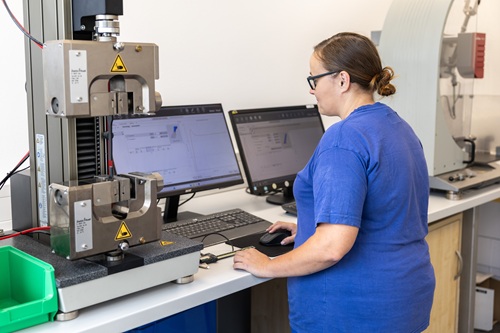
The data collected is recorded and analysed digitally.
According to Philipp Felber, a large proportion of working time in quality control is taken up by incoming goods inspections. It is not currently possible to fully automate this area. Whilst documentation has already been extensively digitised and transferred to a database, and measurement data from individual plastics analysis devices can also be imported automatically, the actual sorting, assessment and evaluation of the material remains an important manual task carried out by humans. “I can imagine that, in future, new specific analytical methods, AI-supported systems or humanoid robots will open up additional, supportive possibilities. However, it is important to me that people remain a central component of our quality assurance system. I do not, however, expect manual human inspection of details to be completely replaced,” says Felber, looking ahead to the future.
From waste to a finished product
Once the goods have been received, the actual processing begins. Quality control becomes particularly crucial at the latest during the extrusion stage. At this point, when the waste material is transformed into a product, the requirements also change fundamentally. Whilst waste management considerations were previously the main focus, the resulting granulate must now meet defined product specifications.
Numerous quality parameters are therefore determined for each batch. These tests form the basis for the so-called ‘Certificate of Analysis’ or the factory test report. This provides the customer with documented proof of quality. They must be able to rely on the material possessing the properties required for their production process.
Felber therefore describes quality control as an indispensable part of the company – as a central monitoring body throughout the entire production process: from the material arriving at the plant, through all processing and production stages, to the granulate leaving the company.
Artificial intelligence for greater process reliability
A further step towards the digitalisation of quality assurance has been taken with the first-ever integration of AI-supported process monitoring into the injection moulding process. The in-house injection moulding machine is a key quality-related process step, as it is here that standardised test specimens for subsequent material testing are produced from the manufactured granulate. Stable and reproducible process conditions are therefore of paramount importance.
The ‘iQ process observer’ enables continuous, AI-supported monitoring of the injection moulding process for the first time. It monitors the five phases – plasticising, injection, cooling, demoulding and production – whilst continuously recording and analysing hundreds of process parameters. The AI continuously evaluates the process data, helping to identify deviations at an early stage, optimise processes in a targeted manner and avoid potential scrap. The results of the data analysis are clearly displayed directly on the machine control system and via a portal.
This means that quality is not merely assessed once the test specimen is complete, but is actively ensured during its manufacture. AI-supported process monitoring thus complements existing quality checks by providing continuous oversight of the manufacturing process, creating an additional level of process reliability and reproducibility.
Random sampling with a great deal of responsibility
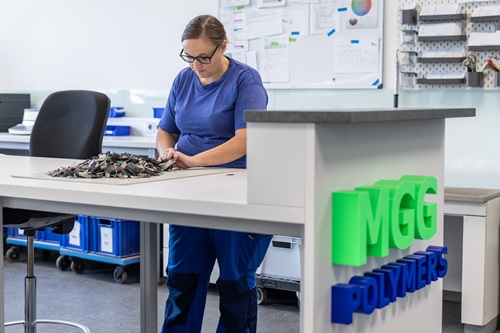
Laboratory assistant Manuela Holzinger going about her daily work in the laboratory.
Despite the considerable testing effort involved, it is not possible to examine every single kilogramme of material thoroughly in an industrial recycling process. The quality system therefore relies on targeted, representative samples taken from the production batches. For certain quality tests, a defined composite sample is used and analysed comprehensively using state-of-the-art testing equipment. This enables the quality of the material produced to be reliably monitored and documented.
Regulatory framework – a growing challenge for plastics recycling
One of the greatest challenges in plastics recycling today lies not solely in the technical processing of the materials, but increasingly also in the changing legal framework. The requirements regarding chemical substances in products and materials are being continuously tightened at European level. For recycling companies, this means that, in addition to the technical properties of a plastic, its regulatory classification is also becoming increasingly decisive for its further recyclability.
A particular challenge arises from the long service life of many electrical and electronic devices. Products that are sent for recycling today were often manufactured ten, twelve or even 15 years ago. At that time, the requirements for certain chemical substances were, in some cases, different from those in force today. Substances that were permitted at the time and specifically used to ensure, for example, flame retardancy, UV resistance or other technical properties may now be subject to significantly stricter regulatory requirements.
Examples of these include Dechlorane Plus, UV-328 and certain flame retardants such as triphenyl phosphate. For Dechlorane Plus, for instance, very low limit values now apply; the European POP Regulation stipulates a limit value of 1 mg/kg as a general rule from April 2028.
This poses an enormous challenge for mechanical plastics recycling. The industrial sorting technologies currently available can distinguish plastics, for example, by polymer type, colour or other physical characteristics. However, they cannot specifically identify a chemical additive contained within a plastic and remove it from the material. Downstream process steps such as extrusion and filtration are also not designed to selectively remove such chemical elements present at a molecular level within the plastic. The specialist literature describes precisely this limitation of material recycling: additives, flame retardants and other harmful substances often cannot be completely removed using mechanical processes.
This creates a tension between regulatory requirements and the recycling technologies currently available. A plastic may be technically very easy to sort and process, and may possess high-quality mechanical properties, yet still be unsuitable for certain applications or markets simply because it contains a single regulated substance. For a recycling plant, such a regulatory change can therefore, in extreme cases, become a ‘show-stopper’.
The challenge here is not to question stricter requirements in principle. Environmental protection and safeguarding public health are essential objectives of a functioning circular economy. Rather, it is crucial that regulatory requirements and technological possibilities are considered together. Recycling companies need sufficient time to adapt processes and technologies to new requirements – particularly when the substance in question originates from products manufactured many years ago under completely different legal frameworks.
A functioning circular economy therefore requires not only ambitious pollutant limit values but also workable transitional arrangements, reliable analytical methods and, above all, technological solutions that can effectively remove problematic substances from complex post-consumer material streams. As long as such selective removal is not technically feasible for many substances, the question of regulatory acceptability remains one of the key challenges for high-quality mechanical plastics recycling.
Digitalisation, automation, technological innovation and AI as the next steps
Alongside the regulatory challenges, Felber does not view the modernisation of the laboratory as a completed stage of development. Rather, he sees it as the foundation for further improvements. Two areas are of particular focus here: digitalisation and automation. The first steps have already been taken. Quality data is increasingly being recorded centrally in systems, measurement results are being imported automatically, and processes are being documented digitally. This reduces the need for manual data entry whilst improving the analysability of the data.
In future, AI applications could also play a greater role across the entire business process. Possible examples include systems for the automated analysis of quality data, for detecting deviations, for assessing the effectiveness of work processes, or for supporting visual inspections. For Felber, this is not about replacing manual human tasks. Rather, what is crucial for him is to deploy new technologies where they can improve processes, strengthen competitiveness and enhance value creation.
Particularly in difficult economic conditions, modern facilities in the value-added sector, modern business processes, smart product development and firmly established quality assurance are essential prerequisites for maintaining industrial value creation at the site in the long term. The new laboratory therefore represents much more than just additional space and new testing equipment. It is part of an ongoing development process with a clear objective: to reliably transform a heterogeneous waste stream into a high-quality, documented raw material that customers can rely on. And the quality of this raw material is not only to be monitored, but also continuously improved.
Ensuring quality, driving innovation and enhancing value creation
Particularly in challenging economic conditions, modern facilities throughout the value chain, efficient and up-to-date business processes, smart product development and firmly established quality assurance are essential prerequisites for securing industrial value creation in the long term.
The new laboratory therefore represents much more than just additional space and modern testing equipment. It is a further building block in an ongoing process of development and digitalisation. The aim is clear: to reliably transform a heterogeneous waste stream into a high-quality, documented raw material that customers can rely on. Quality is not merely checked at the end of the process, but is consistently safeguarded, monitored and further developed throughout the entire value chain.
The new infrastructure embodies a modern and holistic approach to the recycling industry. It lays the groundwork for the continuous development of the entire process chain, ensures quality at an early stage, and enables new requirements to be specifically incorporated into product and process development. This lays the foundations for reliable products, stable processes and sustainable value creation at the site.
We must not only master the technical aspects of recycled plastic, but also develop it further from an economic perspective. This is precisely our ambition: to create high-quality, reliable and competitive products from complex material streams.
The new laboratory is far more than just an investment in testing capacity. It is an investment in our technological expertise, in the quality of our products and, ultimately, in the future of industrial value creation at this site.